
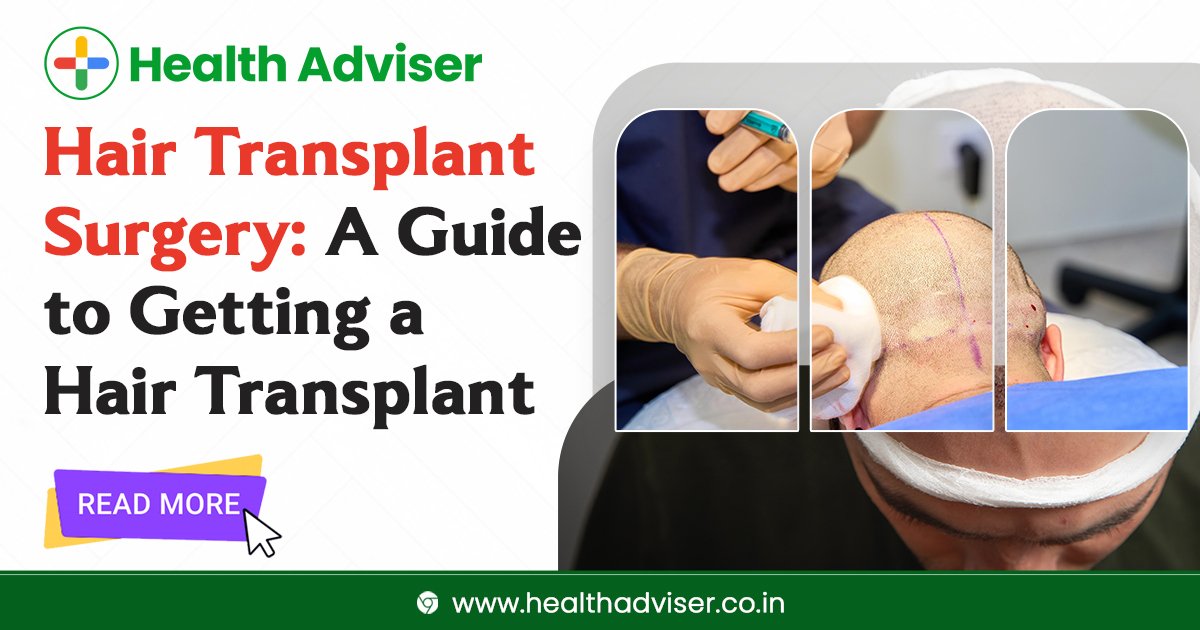
Introduction to Hair Transplant Surgery
Most of us take our looks for granted like good health and youth that is until they’re gone. For many people, a hair transplant treatment can help bring back what looks like a full or at least a fuller head of hair.

If going bald really bothers you, then this procedure can be one way to feel more confident about your looks. But first, consult with your Hair Transplant doctor to discuss what you can expect during the surgery and after the Hair Transplant surgery?
Find here healthy hair tips. Continue your reading online health advice’s hair transplant articles about how to get hair transplant surgery.
Well, the procedure of hair transplant involves the shifting of hair roots from the donor portion to the recipient so that he can get back the original hair from the cells inserted as an effect of the natural and aesthetic aspect of the hair transplant procedure. Read more about what’s a hair transplant.
What is a Hair Transplant?
Hair Transplant is a surgical procedure for treatment of baldness and is suitable for both men and women in which hair follicles are transplanted from the donor area to the recipient area. It is a quick and easy way to treat any type of hair loss problem.
Hair Transplantation process aims to restore a person’s lost hair that may arise due to several reasons such as male baldness, trauma, burns, and surgery.
Hair Transplant is a treatment where hair follicles are taken out of the hair growing scalp on the back and side of the head of the donor and are then transferred and planted again on the barren areas of the recipient.
There are two types of hair transplant treatment which are FUE (Follicular Unit Extraction) and FUT (Follicular Unit Transplantation).
FUE (Follicular Unit Extraction):
FUE is a no-stitch technique where the grafted follicular units which give the best result in terms of hair density gained and reduces the possibility of scars are implanted in the balding area. It is a method that is especially useful in pattern baldness which is technically known as androgenic alopecia.
The FUE hair transplant surgeries are performed under the supervision of professional hair transplant specialist by giving anesthesia and begin by extracting the follicular units out of donor area. These extracted grafts are now kept in a holding solution till the time recipient area is prepared.
The last step in FUE consists of implantation of follicles that are extracted from the donor to create the hairline as per consultation instructed by the patient. This procedure is less painful and tends to produce more advantages also when compared to earlier transplant treatments.
Advantages of FUE treatment:
- Helps to restore your balding, receding and thinning hair
- Ensures a natural looking hairline
- Low risk of complications
- Less downtime to heal the wounds
- Minimal post-operative discomfort
- Invisible linear scars or stitches
Who should opt for FUE?
- People with a smaller area of baldness
- Who needs fast recovery from surgery
- For the people who have fear of cuts and stitches
- Suitable for active lifestyle persons like sportsmen
The procedure of Follicular unit extraction Method
- First, the hair is trimmed to about 1mm of length. It may not be required if the persons hair is long enough to cover the donor area from which the follicles are to be extracted.
- The next step is to clean the donor area with an antiseptic solution and make it completely free of bacteria.
- The scalp of the patient is then injected with local anesthesia to make the region numb to the needle pricks.
- The grafts are then collected using sterile needle tips. Smaller grafts are usually preferred because they give a more natural look. The grafts are collected in a group of 3-4 hair strands together known as Follicular Units from which the name Follicular Unit Extraction is also obtained.
- The hair grafts are collected and stored in a special solution of cold saline.
- The grafts are then prepared for implantation using an Implanter Pen. The needle of the pen is pricked into the skin in the desired angle and direction of hair growth.
- The skin of the transplanted part forms scabs in about 10 days and falls off.
FUT (Follicular Unit Transplantation):
Follicular Unit Transplant is the hair transplantation latest invention. In this technique, a piece of suitable skin from the correct position on the scalp is chosen for the transplant.
This piece of skin chosen will be cut out and grafted on to the area of the scalp where hair needs to be replenished.
The wounds will be closed by suturing the edges of the skin together once the skin has been cut out. FUT has a higher yield in terms of hair restoration.
This method is highly preferred and considered as the main thing by many patients who are willing to have a long, thin scar on the back of their heads in favor of a higher yield of hair and better results.
Advantages of FUT treatment:
- A large number of Follicles can be transplanted in one session
- The high survival rate of hair follicles
- Lower resection rate (Depends upon the skills of Surgeon)
- Cost-effective treatment
- Less time to achieve hair restoration growth
- Yields better quality hair follicles
Who should opt for FUT?
- People with a larger area of baldness
- For those who desirous of pruning treatment times
- For the people who are not averse to cuts, scars and long recovery period.
The procedure of Follicular Unit Transplantation Method
- First, the donor area, usually at the back or at the sides of the head is trimmed and cleaned using an antiseptic solution to prevent any infection
- The scalp of the patient is then injected with local anesthesia to make the region numb.
- The area to be removed is then marked with a surgical pen with the width and length of the part to be removed depending upon the elasticity of the scalp.
- After removing the donor area it is sutured and closed which leaves a linear scar on the area donated due to the stitches on the skin. However, with the development of the Trichophytic Closure Technique the scar becomes almost negligible to notice and the recovery much faster than before
- The follicles are then extracted from the patch of skin removed by slicing off the skin in thin strips. This is known as Strip Harvesting.
- The grafts are then prepared for implantation using an Implanter Pen or needle. The needle is pricked into the skin in the desired angle and direction of hair growth.
- There is a common misconception that FUT is not as good as FUE. This is because of promoting centers who have made FUT as an invasive procedure and FUE as non-invasive but it is not so since both are invasive procedures.
- It is wise to give FUT hair transplant some thought since it is the most reliable method of hair transplant and is preferred by experts in this field.
- FUE, in fact, removes the follicles of the donor area from which no new hair can regrow, this makes the donor area completely barren and of no use for future implants if required. FUT, on the other hand, removes a small region of the skin of your scalp from which follicles are extracted and harvested.
- With the development of techniques like Trichophytic Closure, the scar after FUT becomes difficult to notice. Hair also starts to grow from underneath the scar which makes it better. FUT also avoids over-harvesting of the donor area.
Disadvantages of Hair transplant:
- It is very important to conclude that the candidate who undergoes transplant should have good general health
- It is an invasive procedure performed under local anesthesia
- The success of a transplant largely depends on the quality of existing donor area
- Recovery will take 8 to 10 months
- It’s a costly affair as it involves precision and delicate handling of the hair follicle
- It may take months for you to notice visible growth in the length of your hair
- Possible side effects such as scalp swelling, itching, and numbness of the scalp
- There is always a chance of the transplanted hair follicles to die off before the occurrence of any re-growth
- The patient is likely to notice bumps and redness on the site of transplantation
- An average hair transplant person is required to be in perfectly healthy condition
- One should trim the head full short on the day of treatment, usually, it’s done in the clinic.
- One can’t wear the helmet for 8 to 10 weeks while driving
- One should compulsorily wear a surgical cap for 20 -30 days post-treatment to avoid any kind of dust
- One can get swelling around the eyes, which is very common
- One can’t drive back home by themselves its better go by cab, not by bike or auto rickshaw as it will be too windy.

What can be expected from Hair Transplantation?
- As patient’s own hair is transplanted in hair transplants, re-grown hair completely simulates the original hair in texture, color, curl, and caliber.
- This transplanted hair can be maintained normally and no medical support or special oils and shampoos are needed. The hair even after transplantation looks natural and will last for life
- It’s highly unlikely that patient will ever lose the transplanted hairs permanently and the transplanted hair always undergoes reshuffling just like the birth hair.
- For every 2-6 years temporary falling of shafts with spontaneous re-growth seen after some interval.
- The hair loss progression is under the control of genetic influence and it is a dynamic phenomenon. So medical treatment is also advised for the existing hair in young age people.
- The number of Sessions depends on the grade of baldness and availability of donor area
Side effects of Hair Transplant Surgery
Hair Transplant Surgery is a fairly easy procedure and there are minor complications or side effects as well. These minor complications can occur so it’s important to prepare yourself in advance. Read here the side effects of hair transplant treatment.
The common side effects are swelling; minor discomfort, numbness, itching, and local inflammation and can be avoided easily if hair transplantation is done under the supervision of experienced surgeon and with good communication with your surgeon. Here are the few side effects of Hair Transplant Surgery.
Thinning: If you have had hair transplant surgery, you need to find that the hair you already had is actually getting thinner. It is one of the normal post-operative conditions and the thickness comes back within few months after surgery.
Bleeding: Bleeding is one of the side effects of hair transplant surgery and this can be stopped by putting pressure on the area of bleeding. In rare situations, the bleeding does not stop, in that case, it might be necessary for the surgeon to do some extra stitching to close the wounds.
Pain: Hair Transplant Surgery is termed as painless surgery but there is actually very little pain involved. About half of the people who have the procedure done will not suffer any pain whereas most others take a mild pain relieved such as Tylenol for a few days which seems to be enough for them.
Itching: It is not unusual for itching to occur in areas affected by hair transplant surgery but it should not last more than a few days. Using prescribed shampoos to wash your hair every day may help you with this problem to diminish.
Swelling: Everyone who has undergone hair transplant surgery has experienced swelling in the forehead and around the eyes. This swelling may last for few days with the worst being of it appearing on the fourth day and for some, a black eye may result.
Numbness: Another common side effect of hair transplant surgery is numbness where patients typically report feeling numbness for several weeks after the surgery which is only temporary.
Recovery
- Patients vary in terms of how long it takes for them to recover from their hair transplant procedure.
- In general, most people need three to four days in order to heal.
- This 3 – 4 day period concurs with an article from National Health Service UK.
- According to NHS, patients may get on with their lives and resume their typical daily activities after 3 – 4 days.
- After the 3 – 4-day healing process is finished, the hair follicles are under the scalp.
- Infection risk is quite low at this point.
- Any discomfort which relates to the operation should also ease by the time that three or four days have passed
Downtime, Self Care & Healing
- With this in mind, you should plan some downtime after your operation which can be three days or it might be a week.
- It depends on your schedule.
- Be sure to take time to rest and heal after your hair transplant.
- It’s important to be kind to yourself, although you should find that the recovery process is not too demanding.
- Your surgeon will recommend self-care techniques which help you to feel as good as possible right after surgery.
- Scabs from a hair transplant tend to start falling off after a week to ten days.
- If you get an FUE or FUT hair transplant, then you’ll need to wash your scalp with very gentle shampoo like baby shampoo.
- You may also need to take medications in order to manage discomfort right after your procedure.
- Ointments, antibacterial solutions, and other health care products may be recommended in order to remove crusts from grafts.
- Avoid scratching or hitting your head because nothing should touch your head during recovery. This can be except when you are touching it to perform some aftercare as directed by your surgeon.
- You should also drink plenty of fluids and stay away from sugar and salt.
- Sleep with two pillows in order to keep your head in an upright position.
Pointers who can help you choose a good place for hair transplant
- The doctor/surgeon performing the procedure should be an AHRS certified doctor/surgeon.
- The dermatologist should have extensive hair transplant training.
- The doctor/surgeon/dermatologist should have recognized training by a pioneer in the field of hair transplantation.
- Check who is going to perform the procedure on you as a lot of surgeons allow their technicians to perform the surgery.
- While a lot of surgeons rely on their technicians for help and with implantation, the supervision and presence of a hair transplant surgeon are very necessary and he should be the one designing your hairline.
- A good surgeon extracts the follicles himself as this minimizes the transection rate (when a follicle is cut midway during extraction or dissection, it’s called transection).
- If a surgeon is offering very low rates, it’s most likely he is getting his technicians to perform the surgery or is putting you in a trainee’s hands.
- Do your research about the surgeon who will be operating on you and ask to see before and after results of hair transplants they have done so far.

Hair Transplant Treatment – FAQs
What are the different techniques of hair transplantation?
- STRIP METHOD or FUT method
- FUE or DHT technique
- The latest method is the combined FUT+FUE technique
- Body Hair Transplantation (Beard + Chest Wall)
What are the various features of high-quality hair transplants?
- URFUG
- Dense Packing
- Mega and Giga sessions
- Trichophytic closure
Can hair transplants fail?
Failure is possible in any surgery but the percentages of failure are very low. Chances of failure can be a result of the patient being an unsuitable candidate or poor work by the surgeon. It is always advisable to go to a clinic someone has recommended to you.
How many procedures will it take?
Quite possibly one, but more than one transplant procedures will be necessary for good coverage on the recipient sites.
Is a hair transplant permanent?
The transplanted hairs will behave just as if they would have done if they had stayed in the donor area, a transplant isn’t guaranteed to last forever, but it will probably last a very long time.
Can women have a hair transplant?
Yes, women can have a hair transplant. However, fewer will be suitable for only men because the pattern of hair loss tends to be more widespread, meaning fewer good donor sites.
When Can I Go Back To Work?
You can go back to work within the next day after the FUE transplant. But with the STRIP procedure, depending on the level of pain, more downtime is usually required to go back to work.
Can I cut or shave the hair after growth?
You can cut, trim and even dye the transplanted hair as it grows continuously for rest of the life and will re-grow after complete tonsuring.
In which cases FUE better than FUT method?
- Anybody can choose FUE over FUT as it depends purely on their individual preference and doctor’s advice.
- For eyebrow, mustache and beard transplantation’s,
- Fronto temporal hairline corrections,
- Post-injury scar corrections, and
- For wide donor area scar correction we prefer FUE.
- Post Strip method cases generally suffer from tight scalps in these cases FUE is the best choice
- Who has a tight donor area (no laxity) and
- Those who do not want a semi-circular scar on the back
- Those who want to maintain their hair very short
Do I need to avoid any particular type of food before the procedure?
Avoid spicy diet, coffee, and tea for the day. You are advised to take a simple breakfast for the morning session and can have light lunch for the afternoon session.
Is laser hair removal improves my skin color?
Yes to say. Laser hair removal improves your skin color to yellow. Read more about how laser hair removal improves your skin color.