
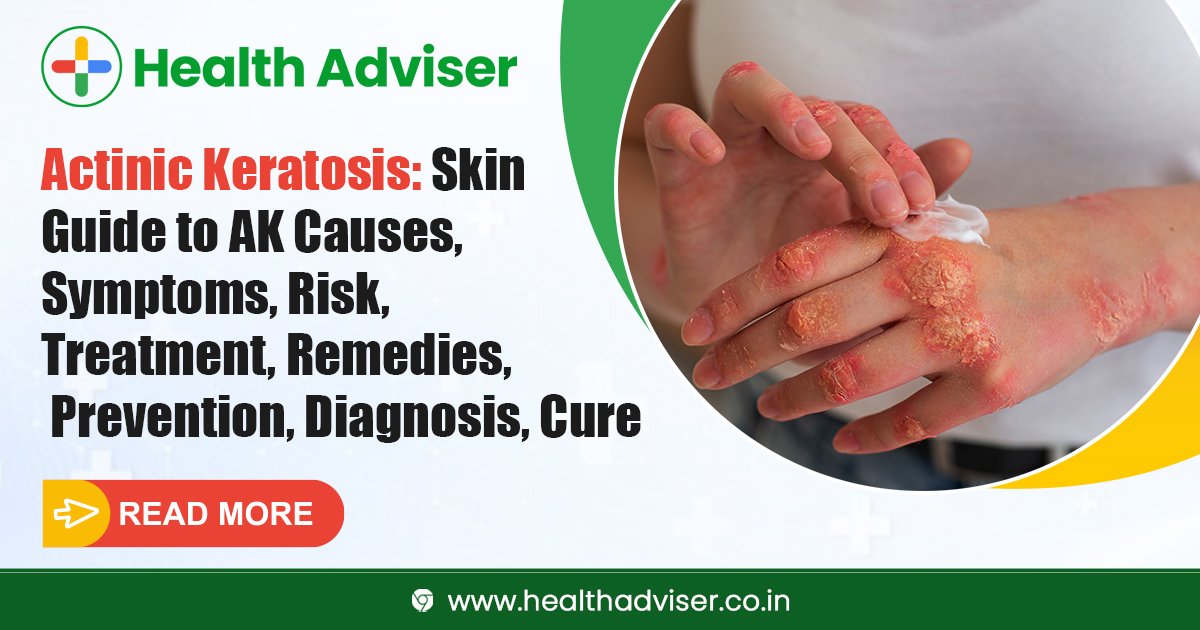
Introduction to Actinic Keratosis
Generally, we observe small spots or patches, moles, freckles, bumps and birthmarks appearing on our face, head, and other parts of our body. We also observe they disappear a few days later. But coming to actinic Keratosis, these are somewhat different from the spots that we usually observe on our body.

Sometimes, some Actinic Keratosis patches may go away on their own but most of them will remain and cause the problem to the area they appeared and may lead to cancer. So, the actinic Keratosis should not be ignored and it needs to be treated as soon as possible.
What is the Actinic Keratosis?
An Actinic Keratosis (AK), also known as a solar Keratosis is a skin condition characterized by is a crusty, scaly growth of patches on the skin of the face, lips, and ears, back of hands, forearms, scalp and neck caused by damage from excessive exposure to ultraviolet (UV) radiation from sun.
It is considered by many doctors as a precancer because it could develop into skin cancer if left alone. Most often, actinic Keratosis develop slowly and reach a size of one inch or less in diameter. They appear in people with fair-skinned, middle-aged or elderly individuals who are above 40 years with a single lesion or many.
These patches take a long time (maybe some years) to develop. During an early stage, they may disappear but reappear later. Occasionally they may itch or produce a pricking or tender sensation on the affected area. They can also become swollen and surrounded by redness. Actinic Keratosis can even bleed in some rare cases.
The chance of getting Actinic Keratosis is slightly higher in men than women because they spend more time outside in the sun and use less sun protection compared to women.
Classification of Actinic Keratosis
AKs can be classified as follows in order to help guide management
Grade 1: This is mild and AKs appears in pink or grey marks with slight scale or is gritty to touch
Grade 2: This condition is moderate and AKs appears in thicker hyper Keratosis and easily detected
Grade 3: This is the severe condition which is hypertrophic, thick keratin
Field change: It covers the areas of several centimeters or more with features of all of the grades of AK.
Sometimes it could be difficult to differentiate grade 3 AKs from small, early SCCs.
Signs & Symptoms of Actinic Keratosis

They are caused primarily due to the areas such as your face, lips, ears, hands, forearms, scalp and neck exposed to the sun. Actinic Keratosis usually causes some signs and symptoms. These include:
- A Flat or slightly raised patch or small spot on your skin.
- The color of the actinic Keratosis can be pink to red to brown, or flesh-colored.
- They are Rough, dry or scaly patch of skin or lesions
- Actinic Keratosis usually is 1 inch or less in diameter.
- They can be a single lesion or several lesions. Later, lesions can develop a hard, wart-like surface.
- Mostly they are recognized by touch rather than sight. If you touch it they feel as if you were running a finger over sandpaper.
- Flat to slightly raised patch
- Bump on the top layer of skin
- Itching or burning in the affected area.
- Skin lesion can persist, grows or bleeds
Causes of Actinic Keratosis
Actinic Keratosis can be caused by many factors but most often it is caused by long-term exposure to sunlight. The following is the list of some of the factors that help in developing this condition:
- The actinic Keratosis is caused by frequent or intense exposure to ultraviolet (UV) rays, typically from the sun.
- In rare some cases, extensive exposure to X-rays can also cause actinic Keratosis.
- Due to industrial chemicals.
- Due to the ultraviolet radiation is given off by the lamps in a tanning salon.
- The closer you live to the equator, the more likely you to have actinic keratosis.
- Age more than 50.
- Cloudy days are also not safe, because 70-80 percent of the ultraviolet (UV) rays coming from the sun can pass through clouds.
Dos and Don’ts of Actinic Keratosis
Actinic Keratosis can be prevented by taking some measures. It is very important to take care of actinic Keratosis that appear on our body because this condition can be precancerous or an early form of skin cancer.
- Avoid staying in the sun for long hours. You can get sunburn or a suntan. Both of them can result in skin damage that increases the risk of developing actinic Keratosis and sometimes skin cancer.
- Stay protected from strongest Ultraviolet rays between 10 a.m. and 4 p.m
- Use a broad-spectrum sunscreen with a sun protection factor (SPF) of at least 15 on all exposed skin before going out.
- Apply sunscreen for 30 minutes before sun exposure and reapply it every few hours or more often if you swim or sweat
- For more protection from the sun, wear the clothes that cover your arms and legs, preferably white color and use a lip balm with sunscreen on your lips.
- Check your skin regularly and look for the development of new skin growths or changes in moles, freckles, bumps, and birthmarks.
- With the help of mirrors, check your face, neck, ears, scalp and other parts of your other body parts.
Risk Factors of Actinic Keratosis
Anyone can develop actinic Keratosis. But people may be more likely to develop the condition if they have:
- A history of frequent or intense sun exposure or burn
- Pale skin
- Chemotherapy which results in weak immune system
- chronic leukemia, AIDS or organ transplant medications
- Are older than 40
- Live in a sunny climate
- Having red or blond hair
- blue or light-colored eyes
- Tend to freckle
- Burn when exposed to sunlight
- Personal history of an actinic keratosis
- Skin cancer
Complications of Actinic Keratosis
If Actinic Keratosis treated in the starting stage, nearly all actinic Keratosis can be cleared up or removed before they lead to skin cancer. If they left untreated, some of these spots may progress to squamous cell carcinoma, a type of cancer that is not life-threatening if detected and treated early.
Medical advice for Actinic Keratosis
Actinic Keratosis is not life-threatening if it is treated early. Both medical care and self-care is needed in order to prevent the development of Actinic Keratosis. The American Academy of Dermatology recommended using a broad-spectrum, water-resistant sunscreen with an SPF of at least 30.
Diagnosis for Actinic Keratosis
Your doctor will determine whether you have an actinic Keratosis simply by examining your skin by undergoing various tests, such as a skin biopsy where your doctor for analysis in a lab takes a small sample of your skin. A biopsy can usually be done after a numbing injection in a doctor’s office.
Even after treatment for actinic keratosis, your doctor will likely suggest that you have your skin checked at least once a year for signs of skin cancer.
Treatment for Actinic Keratosis
Early treatment should be taken to escape from the risk of actinic Keratosis before they become skin cancers. The choice of treatment depends on the place and severity of the lesion, how many there are, and the choice of the patient.

The keratosis treatment can be done in a number of ways. The patient and doctor will decide on methodology in treatment. These may include:
- Surgical removal and biopsy: The skin lesion or the affected area may be removed and examined if there is a risk of becoming cancerous.
- Laser surgery: It uses intense light to vaporize AK tissue.
- Chemical peel: A chemical solution is applied to the skin to cause blistering and peeling away of the Actinic Keratosis. Temporary redness and swelling will likely to be occurring.
- Cryosurgery (freezing): Liquid nitrogen “freezes” the surface of the skin that causes some skin redness until the area is replaced by new skin. This is used most commonly for treating the Keratosis. It is a quick office procedure.
- Tropical anti-tumor Treatments: If you have a number of or widespread actinic Keratosis, then your doctor may prescribe a topical cream, gel or solution to apply to the affected place. These can treat the skin lesions with less risk of scarring.
- Photodynamic therapy: A chemical is applied to the affected skin. Then the skin is exposed to light to activate the chemical that destroys the abnormal skin cells. There can be seen some burning, stinging, and changes in pigmentation of the skin.
- Chemotherapy: A topical cancer medicine is applied to the entire sun-damaged area or skin lesion. It starts healing within 4 to 6 weeks. Usually before new skin appears the skin turns red and blisters.
- Immunomodulator therapy: It works best to rid the skin of abnormal cells selectively. There may be redness, itching, swelling, and crusting.
- Dermabrasion: This uses a handheld device to make the skin smooth and improve its appearance. It can be used to treat large lesions that are often hard to treat with topical treatments. It leaves the skin red and raw and this procedure can be painful.
- Combination Therapy
- Curettage and desiccation(scraping)
- Curettage
What you can do?
Preparing a list of questions will help you make the most of your appointment because your time with your doctor is limited. The below mentioned are the basic of the questions to ask your doctor before making an appointment:
- Are tests needed to confirm the diagnosis?
- What are my treatment options and the pros and cons of each?
- What will the treatments cost? Does medical insurance cover these costs?
- What suspicious changes in my skin should I look for?
- What kind of follow-up should I expect?
- What to expect from your doctor?
Questions your doctor may ask you include:
- When did you first notice the lesions?
- Have you noticed multiple lesions?
- Have you noticed any changes in the appearance of the lesions?
- Is the condition bothersome?
- Have you experienced frequent or severe sunburns?
- How often are you exposed to sun or UV radiation?
- Do you regularly protect your skin from UV radiation?
How is actinic keratosis treated?
In most cases, actinic keratosis can be treated and cured and the outcome is more favorable if the condition is detected during its early stages. Treatment options include the following:
- Topical (applied directly to the skin) lotions or creams
- Cryosurgery (freezing)
- Electrosurgery (use of an electric current)
- Dermabrasion (An instrument is used to sand the stationary skin)
- Laser resurfacing
- Photodynamic therapy (PDT). PDT uses a cream applied to the skin and a special light to destroy pre-cancer cells of the skin.
The treatment of Actinic Keratosis depends on the location, number, size, and severity of the lesions. A combination of methods might be used in some cases.
Prevention care for Keratosis
Prevention of actinic Keratosis is important because the condition can lead to cancer and can be life-threatening sometimes. Following some Sun safety measures is necessary to help prevent the development and recurrence of actinic Keratosis patches and spots.
- Take these steps to protect your skin from the sun: avoid spending time in the sun between 10 a.m. and 2 p.m to escape from the risk of getting sun burn or a suntan.
- Use sunscreen: Make use of sunscreen on all exposed skin daily which reduces the development of Actinic Keratosis.
- Cover up: wear the cloths that cover your arms and legs for extra protection from the sun.
- Check your skin regularly and report changes to your doctor: Use a mirror and check your face, neck, ears, and scalp regularly and look for the changes in existing moles, freckles, bumps and birthmarks and development of new skin growths.
Self Care for Actinic Keratosis
Self-care involves patient education, ongoing self-directed treatment regimens, knowing of the risk of skin cancers, and how to resist the risk. The guideline also emphasizes that patients should be made aware of the side-effects of treatment before they start their regimen. The following are some guidelines to follow.
- Less exposure to UV rays, using sunscreens
- Wear sun protective clotting
- Even after treatment for actinic keratosis, you have your skin checked at least once a year for signs of skin.
- Immune system can be weakened by extensive UV exposure and its ability to repair UV damage also be effected.
- Avoid tanning beds
What happens if actinic keratosis goes untreated?
A percentage of 0.1% to 14%, depending on the study goes on to become cutaneous squamous cell carcinoma (SCC). Unfortunately, we have no good data to help us choose which ones will or won’t progress.
Some proxies we use are size and thickness (degree of hyperkeratosis—a fairly subjective clinical measure). Also, those located on the lip are usually treated not because they are more or less likely to become SCC but because the lip has the highest rate of metastasis for SCC.
Treatment options include physical debridement by liquid nitrogen, laser, chemical peel, or curettage, immunologic treatment with imiquimod or ingenol mebutate, chemotherapy with topical 5-fluoruracil, or other methods like photodynamic therapy or topical diclofenac.
Cancer risk and actinic keratoses
In some cases, actinic keratoses might eventually turn into a type of skin cancer called squamous cell carcinoma (SCC) if they’re not treated. You will be at a higher risk if you have lots of patches for a long time.

People with several patches have around a 1 in 10 chance of getting skin cancer within 10 years of first developing actinic keratoses as per Research suggestions.
Signs, when the patch turned into cancer, include it:
- growing quickly
- hurting
- bleeding
If you have any of the above-mentioned symptoms, if you get any new patches or lumps on your skin, then see your GP. SCC can usually be treated successfully at an early stage.
FAQS of Actinic Keratosis
1. How to reduce the risk of Actinic Keratosis?
You can reduce your risk of actinic Keratosis by minimizing your sun exposure and protecting your skin from UV rays.
2. Whom should you consult when you have the symptoms of Actinic Keratosis?
You need to seek help from your doctor and he/she will refer you a dermatologist if needed.
3. When to see a doctor?
You need to see a doctor when you identify any unnatural spots that occur on your body with swelling or bleeding.
4. Can an actinic keratosis cause skin cancer?
An Actinic Keratosis is a precancerous condition which can signal the possibility that skin cancer may develop. It needs to be examined by a dermatologist.
5. How to identify a cancerous spot?
It is difficult to discriminate then on cancerous spots from cancerous ones. So it’s best to have new skin changes which have been evaluated by a doctor especially if a spot or lesion persists, grows or bleeds.
6. Can the immune system be affected by sunrays?
Yes, you should be aware that extensive UV exposure itself suppresses the immune system and reduce its ability to repair UV damage.
7. How do I protect my skin from Actinic Keratosis?
The only way to protect your skin from Actinic Keratosis is to limit your time in the sun and apply sunscreen to your body.
8. Is there any chance of recurrence of actinic Keratosis after treatment?
Yes, Actinic Keratosis can reoccur when you are exposed to the sun. So, Sun safety is necessary to help prevent the development and recurrence of actinic Keratosis patches and spots.
9. Do I need a regular skin exam?
Yes, it is mandatory y for you to go to a dermatologist for regular skin checkups for preventing the development of actinic Keratosis and to identify the new or changing skin growths.
10. How much does it cost for the treatment of Actinic Keratosis?
You need to fix an appointment with one of your physicians. Once your skin had been examined then your doctor will discuss the options for treatment and the costs.
11. Who is most prone to developing an Actinic Keratosis?
Mostly the actinic Keratosis appears in people aged 40-50, anyone who is excessively exposed to sunlight, especially people with light-skin, is susceptible.
12. How is an Actinic Keratosis diagnosed?
A surgical biopsy may be performed to know whether the lesion has become cancerous. The procedure is small and painless.